Nohadon
The Way of KingsNohadon is the ancient king who transforms a fragmentary historical memory into a living argument about leadership. In Dalinar Kholin’s visions, he is revealed as the source behind sayings preserved in The Way of Kings and as a ruler who confronted the collapse of his own confidence in human beings. His importance lies not only in what later generations remember of him, but in the tension between the remembered aphorist and the frightened, burdened man who had to decide how a broken society might continue.
Identity and Historical Image
Nohadon is identified as a great king whose words became foundational to The Way of Kings. Dalinar learns that the book served the Knights Radiant as a guide to living and that Gavilar Kholin had become deeply interested in it near the end of his life. The surviving wisdom associated with Nohadon therefore reaches the present through several layers: an ancient ruler’s experience, a book used as counsel by the Radiants, Gavilar’s late preoccupation with that book, and Dalinar’s attempt to understand both the text and his own visions.
The book’s sayings are not presented as detached maxims. Dalinar recognizes one of them while standing beside the author himself: the principle that loss has value when it brings learning. Nohadon responds with familiar warmth when Dalinar turns his own sayings back upon him, confirming that the historical voice preserved in the book belongs to a man who could still be confronted, questioned, and contradicted. This encounter gives the old text an embodied origin. Its authority comes not from an abstract ideal king, but from a ruler who spoke after witnessing devastation and who remained uncertain about what his words could accomplish.
The Vision and the Crisis of Rule
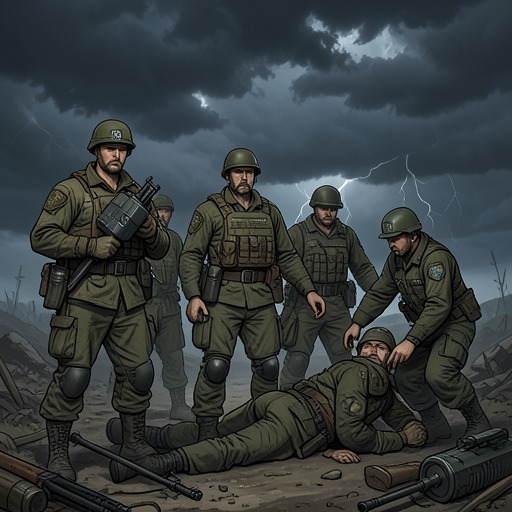
Dalinar encounters Nohadon in a vision set among the wreckage of a devastated place. Burning stations have been established in the distance to cremate the dead, while the balcony around them is broken and torn. The physical ruin matters because Nohadon’s political anxiety is inseparable from the material consequences of failed leadership. He does not speak from a secure throne or a triumphant battlefield; he speaks amid evidence that war has already shattered the structures meant to protect the people.
Nohadon explains that he has lost faith in human cooperation. In his experience, two people find something to argue about, while larger groups discover reasons to oppress or attack one another. The immediate problem is not merely military defeat but the recurrence of division: a society unable to prevent its own members from turning against each other. His fear is therefore both practical and moral. He must determine how to protect people from a pattern that seems to reproduce itself whenever they gather.
That despair produces a decisive reversal in his character. Nohadon considers giving up his throne. The possibility alarms Dalinar, who urges him not to abandon the position from which he might still act. Yet the contemplated abdication shows that Nohadon’s kingship is not founded on effortless certainty. He is willing to question the institution that defines him when it appears incapable of preventing further ruin. His authority is tested precisely because he understands its limits.
The Way of Kings as a Political Response
Dalinar proposes that Nohadon dictate a book: a grand work that would offer hope and explain a philosophy of leadership and the conduct of life. Nohadon’s first response is incredulity at the idea of himself writing a book. The exchange establishes The Way of Kings as a deliberate response to political failure rather than a neutral record of old wisdom. The book is imagined as an instrument capable of preserving principles beyond the lifespan of a single ruler and of giving later generations a framework for resisting the causes of collapse.
Its central concern is the conversion of private experience into public guidance. Nohadon’s loss of faith in people is not allowed to remain a private conclusion. Through the proposed book, his doubts can become a structured examination of how people should live and how leaders should govern. The work thus joins ethics to statecraft: hope is not sentimental consolation, but a means of organizing conduct after catastrophe.
The same political problem appears in the present-day crisis of Alethkar. Dalinar remembers the command to unite and connects it to Gavilar’s earlier interest in assigning specialized responsibilities to the ten highprinces. That older arrangement had once forced the rulers of the autonomous princedoms to submit to one another’s authority, but it had been abandoned for centuries. Nohadon’s legacy consequently becomes relevant not because Dalinar can reproduce an ancient kingdom exactly, but because its underlying demand is cooperation rather than nominal allegiance.
Influence on Dalinar Kholin
Nohadon functions as a mentor within Dalinar’s visions, but the relationship is unusually reciprocal. Dalinar seeks guidance from the ancient king, yet he also urges Nohadon not to surrender his throne and supplies the immediate idea of writing a book. The vision does not reduce Nohadon to an oracle who delivers complete answers. Instead, it places two rulers from different ages into dialogue about the same problem: how to prevent a divided people from becoming their own enemy.
Nohadon’s sayings help Dalinar reinterpret his own conduct. Dalinar has been troubled by visions that seem to demand preparation, unity, and the construction of a fortress of strength and peace against the coming Everstorm. He hesitates to explain these experiences because they appear to violate doctrine and common sense. Nohadon’s presence gives those imperatives historical depth. The command to unite is no longer only an inexplicable voice in Dalinar’s mind; it resonates with an older political philosophy shaped by the collapse of civilization.
This influence changes Dalinar’s practical objectives. Rather than treating the war on the Shattered Plains as a collection of rival campaigns, he decides to seek genuine coordination among the highprinces. He plans to become Highprince of War, enforce the Codes in all ten camps, coordinate plateau assaults, place the gemhearts under the Throne for distribution as spoils, and turn the competing armies into a real army. Nohadon’s legacy therefore operates through institutional reform. The ancient king’s concern with unity becomes, in Dalinar’s hands, a plan to transform rivalry into common purpose.
Legacy, Conflict, and Narrative Significance
Nohadon’s legacy is surrounded by misunderstanding. Adolin Kholin initially interprets Dalinar’s connection to the Radiants and to The Way of Kings as evidence that his father’s visions are delusions arising from guilt over Gavilar’s death. The old king’s importance is thus concealed by the uncertainty of the medium through which he appears. To skeptics, Nohadon belongs to a dangerous network of religious and historical fantasies; to Dalinar, the vision gradually becomes a source of responsibility.
The novel also places Nohadon’s political ideal against several contrasting systems. Shinovar treats warriors as the lowest class while honoring farmers, and Babatharnam grants greater authority to the elderly, with its king called the Most Ancient. These examples show that Roshar contains multiple theories of status and rule. Nohadon’s distinctive concern is not simply who should hold office, but how authority can prevent factional violence and preserve a people through crisis. His model is measured against societies that organize power through occupation, age, or inherited hierarchy.
Most importantly, Nohadon’s story links memory to renewal. The Way of Kings preserves the counsel of a ruler who once confronted despair, while Dalinar’s visions return that counsel to the conditions that produced it. Nohadon’s significance is therefore neither purely historical nor purely prophetic. He represents the moment when catastrophe is interpreted as a demand to learn, when kingship is judged by protection rather than prestige, and when a book becomes an attempt to outlast the recurring human impulse toward division. Through him, the novel frames unity as an achievement that must be built, taught, and repeatedly chosen rather than assumed as the natural condition of a kingdom.